How do you know it's time for a new roof?
The clearest sign is a roof that leaks in a new spot every time the last one gets fixed. That usually means the whole covering is reaching the end of its life, not one tile or one screw.
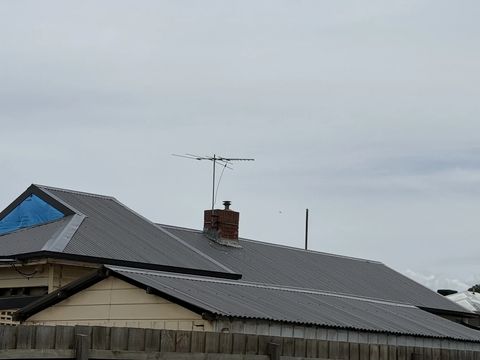
On tiles, look for soft, flaking or crumbling tiles over large areas, not just a few cracked ones near the gutters. On metal, it's rust that has eaten holes rather than sitting on the surface, and screws that won't hold. A sagging roofline points to the timber frame, which a roofer should check before anyone prices a new covering.
Not sure which side of the line you're on? Our restore or replace quiz gives a quick lean, and the restoration vs replacement guide sets out the trade-offs.
Older house? Rule out asbestos before anyone starts
ASSEA, the federal asbestos agency, says a home built or renovated before 1990 probably has some asbestos. If your roof is cement sheeting, often grey and corrugated and sometimes called fibro or Super Six, treat it as asbestos until a test says otherwise. Don't drill, cut, water-blast or walk on it. Removal is licensed work, covered on our asbestos roof replacement page.
What happens on a re-roof, start to finish
Measure and quote
The roofer measures the roof, checks the pitch and looks at the battens and frame from inside the roof space. An itemised quote shows strip-off, materials, flashings and gutters as separate lines.
Set up for working at height
Edge protection or scaffold goes up first. On two-storey homes and steep roofs it's a genuine part of the price, not padding.
Strip the old covering
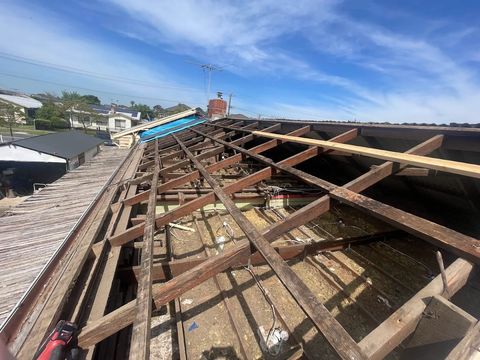
Old tiles or sheets come off and go into a skip. Tiles are heavy, so disposal often has its own line.
Fix what's underneath
With the roof open, rotten or undersized battens (the strips the roof is fixed to) and rafters get replaced, because it's the only time they're easy to reach.
Sarking or an insulation blanket
Sarking (a reflective membrane laid under the roofing) or a foil-faced blanket goes down to stop wind-driven rain and dust and cut the heat coming through.
New roof, flashings and gutters
The new covering goes on, then ridges, valleys and flashings around chimneys, skylights and walls. Many people swap gutters at the same time, while the roofer is set up along the edge.
Clean-up and paperwork
Swarf (metal filings from cutting sheets, which rust and stain) should be swept off the roof and out of the gutters. Ask for written warranties and any compliance certificate your state requires.
What should the new roof be made of?
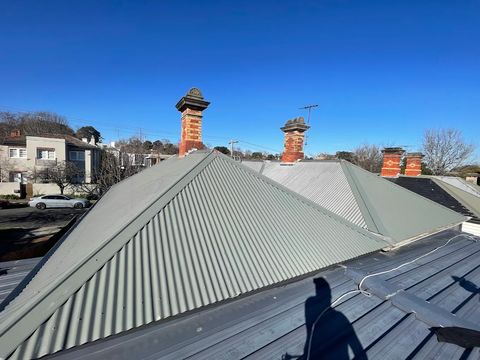
Most Australian re-roofs end up in pre-painted steel sheeting, which many people know by the brand name Colorbond, or in tiles. Steel is lighter and quicker to lay. Concrete and terracotta cost more to lay, but some owners want to keep the look of the house or street.
Swapping tiles for steel changes the battens, the flashings and how the roof sounds in rain, so it has its own page on tile to Colorbond re-roofs. See also Colorbond and metal roofing and Colorbond vs tile.
Why two re-roof quotes can be thousands apart
Roof area matters most, and it's always larger than the floor plan once eaves and pitch are added. Our roof area calculator gives a rough figure to hold quotes against.
Then it's storeys and pitch, how many hips, valleys and dormers there are, and what comes off: tiles take longer to strip and cost more to dump than sheets. Timber repairs, gutters, insulation and solar panels all add up, so check every quote covers the same things.
Questions to ask before you sign
- What's your licence number, and does it cover this work in our state? In WA, for example, a re-roof over $20,000 that needs a permit must be done by a registered builder.
- Is strip-off, disposal and the skip in this price?
- If you find rotten battens or rafters, how is that charged?
- Are new gutters, downpipes and flashings in the quote or extra?
- What workmanship warranty do you give, and what's the manufacturer's warranty on the roofing?
- How will you keep the house dry if rain comes while the roof is open?
Your part, and the roofer's part
You can
- Get a rough roof area from our calculator to sense-check quotes
- Look up each roofer's licence on your state register
- Clear a spot near the house for the skip and deliveries
- Move anything valuable out of the roof space
Leave to a roofer
- Stripping and disposing of the old roof
- Scaffold, edge protection and all work at height
- Battens, rafters, sarking, flashings and gutters
- Any asbestos, which needs a licensed removalist
If it were our roof
We wouldn't price a replacement until a roofer has been up, photographed the roof and shown why repair or restoration won't do. Then we'd get two or three itemised quotes in the same material so the numbers actually compare. If the budget is tight, we'd put the money into battens, sarking and flashings before upgrading the roofing itself. Those are the parts you won't get another easy chance to fix.
Want a roofer to take a look?
Tell us the job and your postcode. We match it with a Find My Roofer certified roofer who specialises in that kind of work, and they call you to quote. Your number goes to them alone.